The long version

Scroll to turn the page →

Cover

I've never had one career.
I've had one job.

The titles changed — rep, manager, director, executive. The work never really did: walk into something that isn't working, find where it comes apart, and rebuild it so it holds.

Chapter 01 — The floor

It started on a sales floor.

I was the number one rep. That sounds like a story about selling. It isn't. What I actually learned on that floor is that closing was never the hard part — the hard part was everything that happened to a customer after they said yes.

Promises made on the phone. Handoffs to people who never heard the call. Systems that forgot what we agreed to. I was winning at my job while the company quietly lost the customer.

That gap between the sale and the delivery is where I've worked ever since.

What the floor taught me

Sellinglearnable
Keeping the promiseorganizational
Where revenue diedbetween teams

Chapter 02 — The pattern

Different companies. Same broken seam.

Healthcare. Medical devices. Solar. Distributed sales organizations. Regulated businesses. Different industries, different products, different problems on paper.

Underneath, it was always the same shape. Every department could show you a dashboard where they were winning. Nobody owned the space between the dashboards. That space is where the money went.

Once you can see that pattern, you can't unsee it.

Same shape, different rooms

National health marketplaceenrollment → onboarding
Medical device distributorCRM → pipeline
Residential solarsale → install
Distributed sales orghiring → productivity

Chapter 03 — The operator

I stopped fixing departments.

Somewhere along the way I stopped being the person who improved a function and became the person who redesigned how the functions fit together. That's a different job, and most org charts don't have a box for it.

It means asking uncomfortable questions. Who actually owns this? What happens the moment this leaves your hands? What are we measuring that nobody acts on? Which of these meetings exists because the system can't answer a question by itself?

The org chart tells you who reports to whom. It never tells you how work moves.

The questions I keep asking

Who owns this?accountability
What happens next?handoff
Who acts on this number?signal vs noise
Why is this a meeting?system gap

Chapter 04 — The multiplier

Then AI showed up, and it felt familiar.

When people started asking what to automate, I noticed the question was pointed the wrong way. Automation isn't the goal. Allocation is. What should a machine carry so a person can do the part only a person can do?

It also felt oddly personal. The way I'd always worked — connect everything to everything, remember what happened, act on what matters, don't lose the thread — is roughly what these systems do. I wasn't learning a new way to think. I was finally getting tooling for the way I already thought.

Not artificial intelligence replacing people. Intelligence, multiplied.

The allocation question

Machinesscale, memory, repetition
Peoplejudgment, trust, consequence
The mistakeasking one to do the other's job

Chapter 05 — The build

So I built the thing I kept wishing companies had.

Not a dashboard. Not twenty disconnected automations. An operating architecture where the truth lives in one place, work gets routed to whoever — or whatever — should handle it, memory survives turnover, and nothing irreversible ships without a human saying go.

A production version of it runs today inside a live, highly regulated insurance operation: claims, documentation, deadlines, signatures, internal reviews, compliance-sensitive workflows. Real consequences, real audit trail.

If a system can survive compliance, it can survive your Tuesday.
AI²OS, in one breath

One source of truthshared
Work routinghuman · process · agent
Institutional memorypreserved
Approval gatesenforced

See the build →

Chapter 06 — The person

I'm not a technologist. I'm an operator who likes people.

I like messy problems, simple language, whiteboards with too many arrows, and systems people actually use. I'd rather fix a handoff than admire an org chart.

Outside the work, the important part is family — the reason I care whether a system gives people their evenings back.

If the smartest system in the world makes the employee miserable, it isn't smart enough.

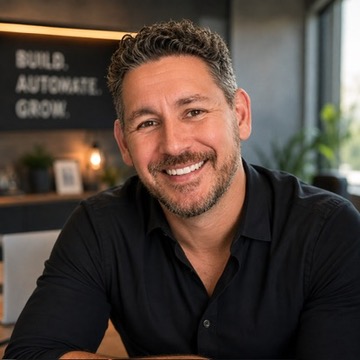
Dwayne Vera
Dwayne Vera · Operator

Chapter 07 — Now

Looking for the right seat, or the right problem.

Executive leadership with real operating ownership — GM, COO, transformation, business systems, AI operations. Or a company that knows the way it works today won't carry the next stage of growth, and wants someone to redesign it.

Start the conversation See the receipts

Dwayne Vera — the long version Page 01 / 08

Keep going